
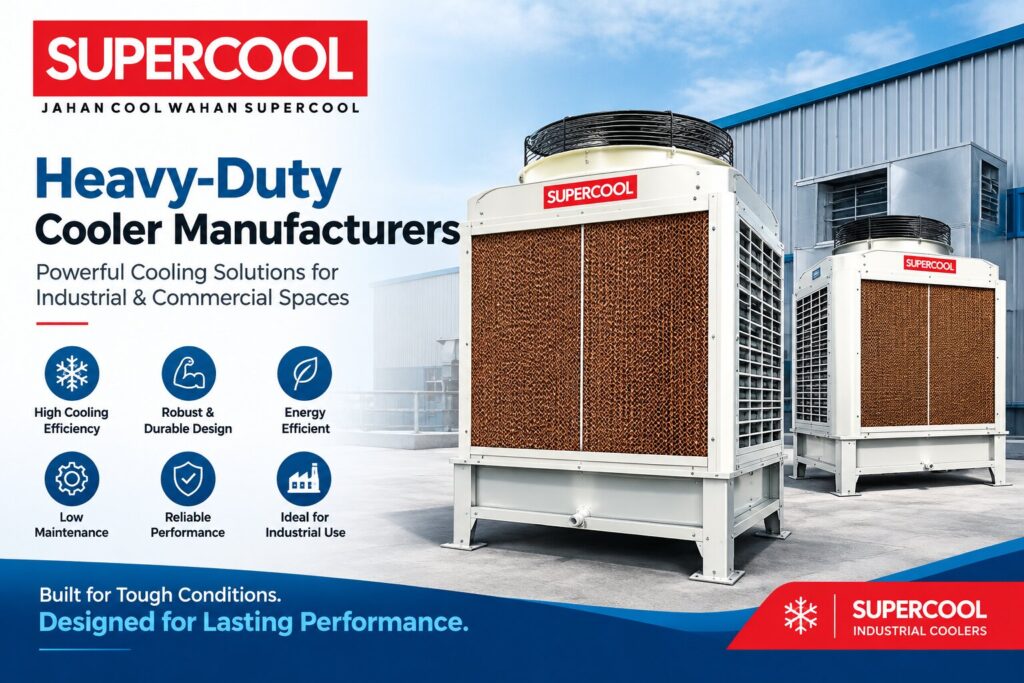
Big commercial buildings require cooling systems that can move air efficiently across a large area and work reliably throughout long hours of use. Factories, warehouses, workshops, showrooms and large halls have different requirements based on their features and how they are being used. Heavy-duty cooler manufacturers provide commercial cooling equipment in several capacities. Therefore, it is essential to know the data before a required product is chosen. Air output, water tank size, cooling pad design, engine efficiency, and operating requirements all affect how well the cooler functions in a given environment.
Understand the Cooling Requirement
The first thing to do is analyze the space to be cooled. Factors such as the area’s dimensions, ceiling height, capacity, and ventilation level will all affect the amount of cooling required. An open workspace with good ventilation will have different cooling requirements than a large commercially enclosed area.
Layout is also important. There are many kinds of equipment and furniture that may interfere with the circulation of air. In some large areas, several strategically placed units would give better results compared to a single high-capacity air conditioning unit.
Important Considerations for Heavy-Duty Coolers
Air Delivery
Air delivery refers to how much air is being circulated by the cooler. It is a vital factor for large commercial and industrial buildings that require air to be delivered to a huge area. With greater capacity for air delivery, the air can be circulated over greater areas, making it a vital attribute when comparing coolers used in warehouses, factories, workshops, and bigger halls.
Water Tank Capacity
The water tank capacity is critical to the working time of the cooler before it requires a refill. A larger tank is useful in places where cooling is needed throughout the working day. When considering the tank capacity, it is also important to think about the air delivery and cooling efficiency.
Cooling Pad Performance
Cooling pads are the most crucial component in the process of evaporative cooling, as they allow the flow of air through the moist pads, leading to heat transfer from the air to the water and allowing circulation of the cooled air within the room.
Motor and Fan Performance
Both the motor and the blower define how efficiently the air flows through the cooler. This solution is often used in commercial applications and requires constant operation of these mechanical parts and their ability to work properly at all times.
Match the Cooler to the Commercial Space
Factories and Workshops
Production facilities and workshops usually consist of extensive work areas, with machinery, equipment, and personnel scattered around the whole place. A powerful airflow system is very important to help move cooler air in these spaces, especially when doors or other openings allow enough ventilation.
Warehouses and Large Halls
Most warehouses and large conference rooms have relatively spacious ceiling heights and large floor spaces covered by the cooler. Therefore, the cooler should be able to circulate air over longer distances.
Conclusion
You need to look at important things like the air supply, water capacity, cooling system and its working ability while trying to select an ideal heavy-duty cooler. By considering the installation and operating conditions of such units, one can choose the right unit easily. Heavy duty cooler manufacturers that produce several models offer reliable options for various industrial establishments like factories, workshops and showrooms, and others.
Explore the commercial and industrial cooler range by Supercool if you need the best heavy-duty coolers.